
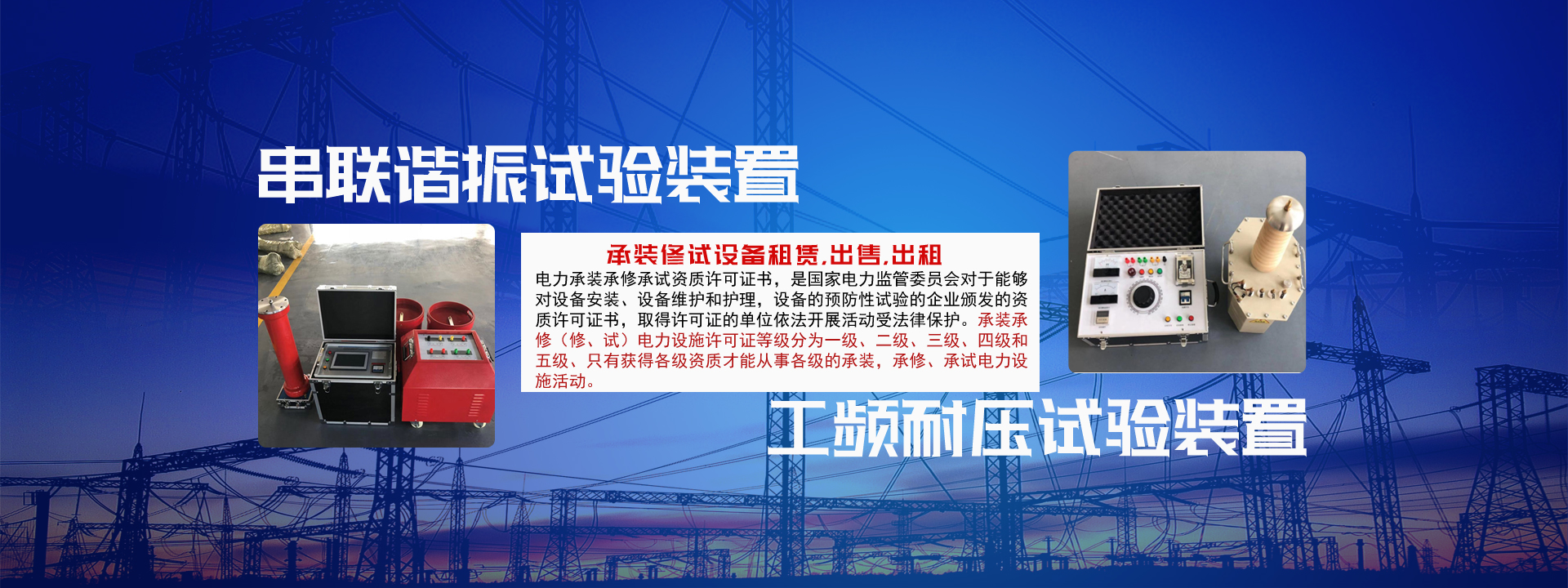
It utilizes the principle of series resonance to generate the required high voltage output under lower input power conditions, and is widely used in withstand voltage tests of high-voltage electrical equipment such as power cables, transformers, GIS (Gas Insulated Switchgear), and motors. The following is a detailed introduction to the series resonance test device:
Working Principle
Series resonance refers to a circuit containing inductance (L), capacitance (C), and resistance (R). When the power supply frequency matches the natural frequency of the LC loop, the circuit exhibits pure resistance, at which point the current reaches its maximum value, while the voltage forms a higher peak across the inductor and capacitor. In a series resonance test device, by adjusting the power supply frequency or changing the inductance/capacitance values, the system can enter a resonant state, thereby producing a very high output voltage with small input power, suitable for withstand voltage testing of large-capacity electrical equipment.
Design Features
High efficiency and energy saving: Due to the use of resonance technology, the required input power is greatly reduced, improving energy utilization.
Lightweight and flexible: Compared to traditional power frequency withstand voltage testing equipment, the series resonance test device is smaller in size and lighter in weight, making it easy to carry for on-site use.
Precise control: Modern series resonance test devices are usually equipped with microprocessor control systems, enabling precise adjustment of output voltage, frequency, and other parameters, and have automatic tuning functions.
Multiple protection mechanisms: Built-in overvoltage, overcurrent, short circuit, and other protection measures ensure operational safety and stable equipment operation.
Data recording and analysis: Supports real-time monitoring and recording of various parameters during the test process, providing detailed data reports and analysis tools.
Application Fields
Power cable testing: Especially in long-distance transmission lines, submarine cables, and other occasions, used to evaluate the insulation performance of cables and their accessories.
Transformer testing: Detects the insulation condition between transformer windings, especially for on-site withstand voltage tests of large power transformers.
GIS and other high-voltage electrical equipment: Used for factory inspection or maintenance of gas-insulated switchgear, instrument transformers, circuit breakers, and other high-voltage electrical equipment.
Motor testing: Evaluates the insulation strength of key components such as stator coils and rotor coils of rotating motors.
Usage Precautions
Safety first: Must strictly comply with relevant safety regulations, wear appropriate personal protective equipment (PPE), and operate in safe areas.
Correct parameter settings: According to the requirements of the tested object, reasonably set output voltage, frequency, and other parameters to avoid equipment damage or affecting test results due to improper settings.
Regular calibration and maintenance: To ensure measurement accuracy and equipment reliability, calibration and maintenance should be carried out according to the manufacturer's recommended intervals.
Environmental conditions: Ensure that the working environment meets equipment requirements, such as temperature, humidity, and other factors that do not adversely affect the test.
Future Development Trends
With the advancement of technology, future series resonance test devices may develop in the following directions:
Improved intelligence level: Introduce more automation functions, such as remote monitoring, fault diagnosis, etc., to enhance user experience.
Multi-functional integration: Develop a comprehensive testing platform with multiple testing functions to meet a wider range of application needs.
Green and environmentally friendly design: Optimize hardware structure and working modes, reduce energy consumption, and minimize environmental impact.
Big data applications: Combine emerging technologies such as the Internet of Things (IoT) and cloud computing to achieve massive data analysis and predictive maintenance, further improving work efficiency and service quality.
If you are writing an article about series resonance test devices, the above content should provide you with a comprehensive and in-depth understanding. If there are more specific topics or details you would like to explore, please feel free to let us know.