
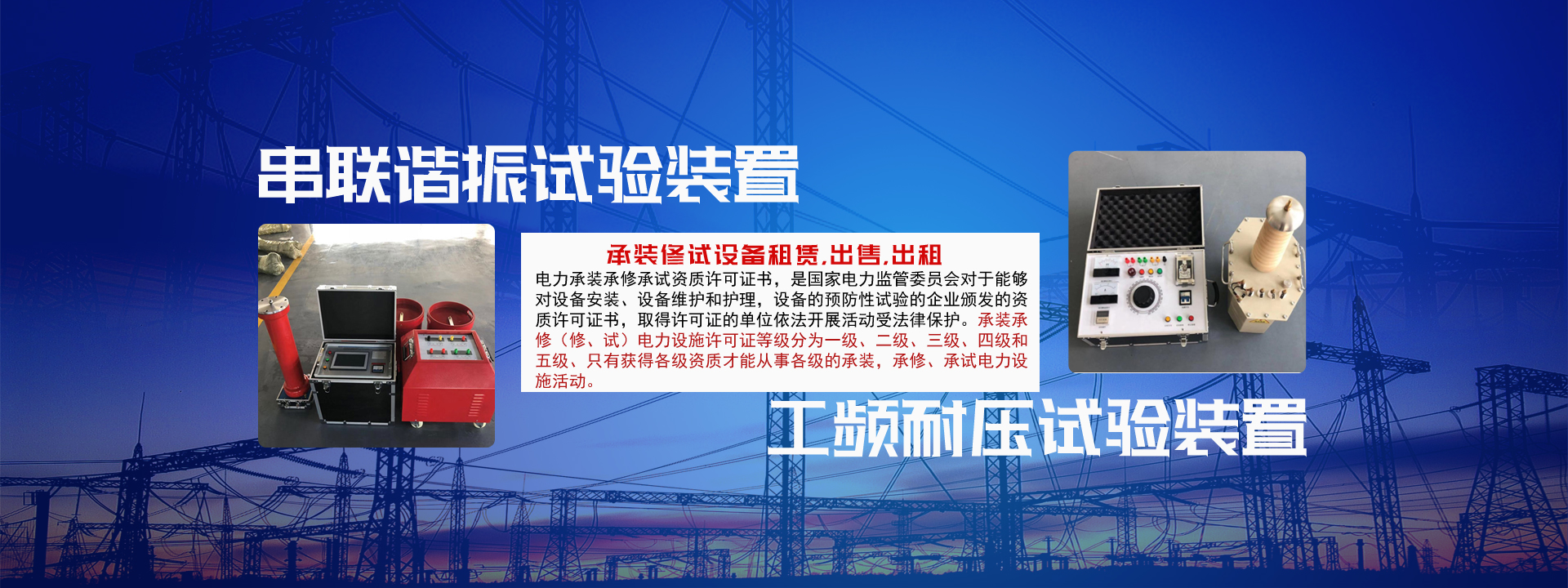
Electrical Characteristic Control Console, commonly referred to as test control console, operating console, or control box in power test sites. It is not the "executor" that directly generates high voltage or large current (that is the work of transformers and generators), but the "brain" and "command center" of the entire test system. Its core role is to safely and precisely control the output of high-voltage test equipment (such as test transformers, series resonant devices, DC high-voltage generators, etc.) and monitor the status of the test object in real time. Without this control console, high-voltage testing would be impossible, as directly manually adjusting the high-voltage side is extremely dangerous and uncontrollable. 1. Core Functions: What Does It Do? The control console mainly undertakes four major tasks: A. Power Regulation and Control (Voltage Regulation) Function: Receives input power frequency supply (220V/380V), and smoothly adjusts the output voltage through an internal auto-transformer or thyristor (SCR) electronic voltage regulation module. Purpose: To allow the voltage on the high-voltage side to rise slowly from 0 (voltage increase), avoiding surges; and to remain stable after reaching the target value (voltage stabilization). Methods: Electric voltage regulation: Uses a motor to drive the carbon brush of the voltage regulator, suitable for large-capacity equipment, with smooth control. Electronic voltage regulation: Adjusts by changing the conduction angle of the thyristor, with fast response, small size, and easy automation. B. Real-time Monitoring and Display (Measurement) High-voltage monitoring: Although the control console is on the low-voltage side, it is connected to a high-voltage divider or the measurement winding of the transformer, and can display the actual voltage value (kV) on the high-voltage side in real time. Current monitoring: Displays the leakage current (mA) flowing through the test object or the high-voltage side current (A) in real time. This is a key indicator for judging whether insulation breakdown occurs. Other parameters: Some advanced control consoles can also display frequency (for resonance tests), time, power, etc. C. Safety Protection (Guardian) This is the most important function of the control console, and multiple protection mechanisms must be provided: Overcurrent protection: When the test object breaks down or short-circuits, causing a sudden surge in current, the control console must cut off the power within 20ms (milliseconds) to prevent equipment damage. Overvoltage protection: Automatically trips when the voltage exceeds the set limit. Zero-position start protection: Requires the voltage regulator to return to the "zero position" before starting voltage increase, preventing impact from closing with voltage. Emergency stop button: A prominent red mushroom-head button that cuts off all output with one press in emergency situations. Audible and visual alarm: When high voltage is output, the control console triggers an on-site audible and visual alarm to warn personnel to stay away. D. Timing and Control Logic Automatic timing: When the voltage rises to the set value (e.g., 50kV), timing automatically starts (e.g., withstand voltage for 1 minute). After the time is up, it automatically reduces voltage or prompts. Programmed operation: Modern digital control consoles can preset test procedures (e.g., voltage increase -> voltage hold -> voltage decrease -> discharge) for one-button automated testing. 2. Main Internal Structure A typical control console internally contains: Voltage regulation unit: Contact auto-transformer (TSGC series) or IGBT/thyristor voltage regulation module. Control unit: PLC or microcontroller system, handling logic, collecting data, and driving displays. Measurement unit: High-precision AD converter, processing signals from the divider. Protection unit: High-speed relays, fuses, overcurrent relays. Human-Machine Interface (HMI): LCD touch screen or digital tube display for setting parameters and viewing results. Input/Output interfaces: Power input socket, high-voltage tail wire output socket, alarm light interface, grounding terminal. 3. Classification and Evolution Traditional pointer-type control console: Features: Uses mechanical pointer meters to display voltage and current, with manual knob or electric voltage regulation. Advantages: Simple structure, strong anti-interference, low cost. Disadvantages: Large reading errors, no data storage, cannot automatically generate reports, and operation relies on manual experience. Digital intelligent control console (mainstream): Features: Large LCD display, full Chinese menu, touch operation.