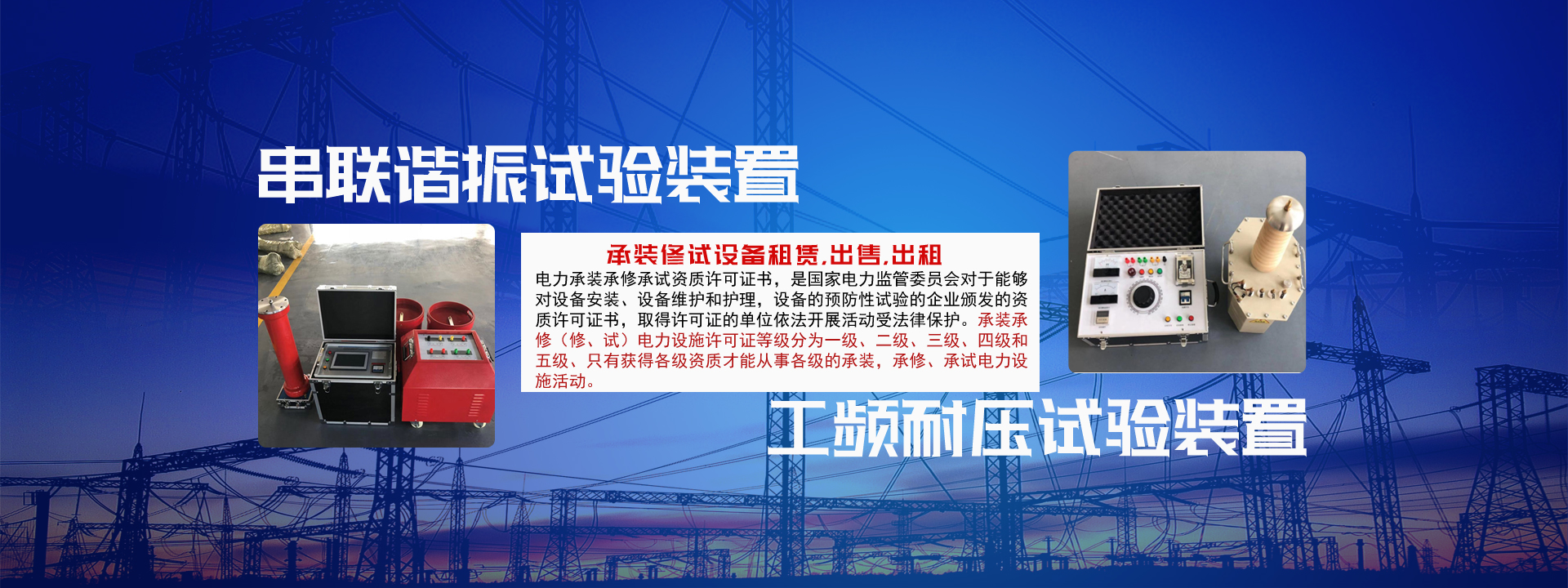
The HDSR portable variable frequency resonant test device is a test device commonly used for insulation withstand voltage tests on large electrical equipment such as generators, cables, and transformers. Due to the relatively large size of the equipment, it is often transported to the site for testing, and it is difficult to avoid bumps and knocks during transportation. If some minor equipment issues occur, we can often solve them on-site to avoid delays. Below, we will discuss some common fault handling methods. The variable frequency resonant device consists of an isolation transformer, a frequency modulation and voltage regulation power supply, an excitation transformer, a reactor, and a capacitive voltage divider. The capacitance of the test object and the reactor form a series resonant connection; the voltage divider is connected in parallel to the test object to measure the resonant voltage on the test object and serve as an overvoltage protection signal; the frequency modulation power output is coupled to the series resonant circuit through the excitation transformer, providing the excitation power for variable frequency resonance. General precautions: 1. This test equipment should be used by professional high-voltage test personnel. Before use, carefully read the instruction manual and undergo repeated operation training. 2. There should be no fewer than 2 operators. During use, strictly comply with the safety operation regulations for high-voltage tests of the unit. 3. To ensure the safety and correctness of the test, in addition to being familiar with this product manual, strictly follow national standards and regulations for test operations. The output is high voltage or ultra-high voltage, and reliable grounding is required. Pay attention to operational safety. Troubleshooting methods: 1. Turn off the instrument power, let the instrument sit for about 30 minutes, press the "Reset" button on the instrument panel, and then restart the instrument. Troubleshooting methods: 1. Check that the grounding device is reliable and the grounding connection wire is intact. 2. Check the high and low voltage lines of the excitation transformer. 3. Check the continuity of each reactor; Cause: The reactor and the test object's capacitance do not match, and the resonance point is not accurately found; the test object has high losses, and the system Q value is too low; the high-voltage output of the excitation transformer is relatively low; Statement: The views expressed in this article are solely those of the author. Sohu Hao is an information publishing platform, and Sohu only provides information storage space services.

- Home
- About Us
- Products
- Series Resonance Test Device
- Power Frequency Withstand Voltage Device
- Electrical Characteristic Console
- High Current Generator
- Transformer Characteristic Test Bench
- Transformer Ratio Tester
- Triple Frequency Generator
- CT/PT Characteristic Tester
- Cable Fault Tester
- Dielectric Loss Tester
- Capacitance/Inductance Tester
- Partial Discharge Tester
- Microcomputer Relay Protection Tester
- ZnO Arrester Tester
- Transformer Capacity Characteristic Tester
- Company News
- Industry Trends
- Messages
- Contact Us
☎
Service Hotline18952707000