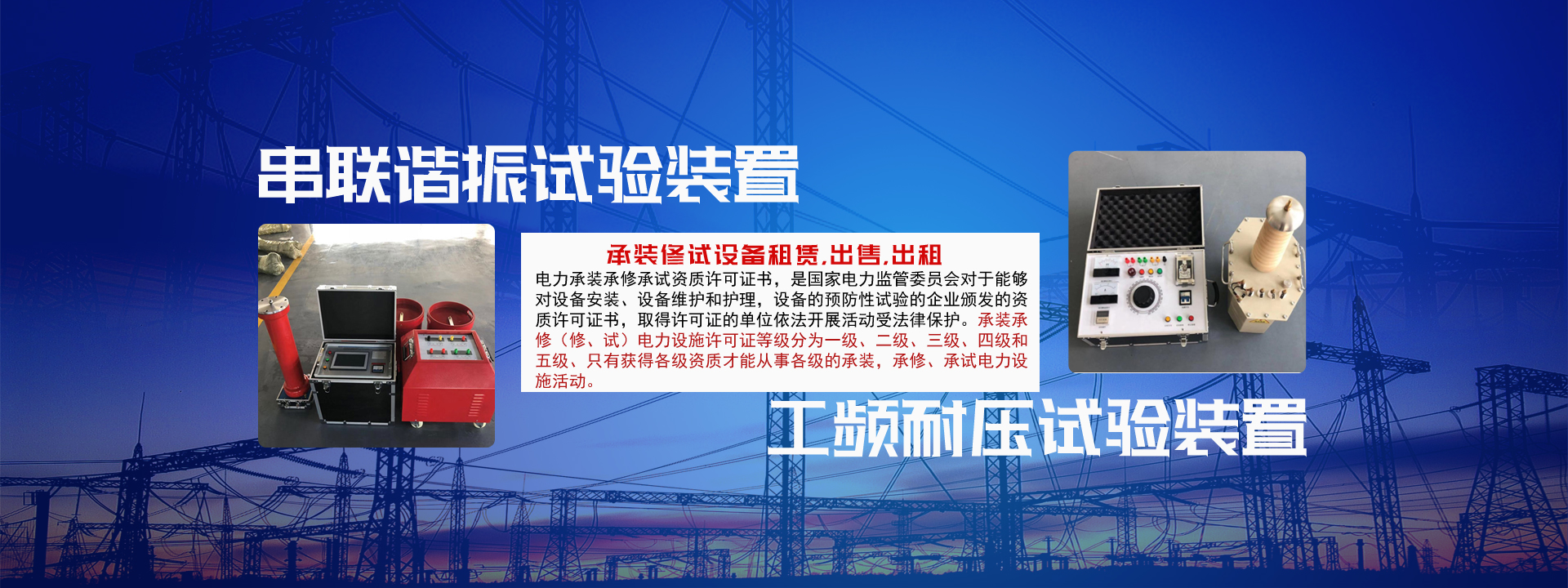
Answer: For AC withstand voltage tests on large-capacity test objects such as long cable lines, capacitors, large generators, and transformers, large-capacity test equipment and power supplies are required, which is often difficult to achieve on site. In such cases, series resonance, parallel resonance, or series-parallel resonance (also known as series-parallel compensation) can be used to solve the problem of insufficient test equipment capacity depending on the specific situation. (1) Series resonance (voltage resonance) method. When the rated voltage of the test transformer cannot meet the required test voltage, but the current can meet the test current of the tested object, the problem of insufficient test voltage can be solved through series resonance. (2) Parallel resonance (current resonance) method. When the rated voltage of the test transformer can meet the test voltage requirements, but the current cannot reach the test current required by the tested object, parallel resonance can be used to compensate the current and solve the problem of insufficient test power supply capacity. (3) Series-parallel resonance method. In addition to the above series and parallel resonance, the characteristics of series resonance circuits can also adopt series-parallel resonance lines simultaneously, also known as the series-parallel compensation method. Answer: In a circuit composed of an inductive coil (which can be simulated by an inductor L in series with a resistor R) and a capacitive element (capacitor C) connected in series, when the inductive reactance equals the capacitive reactance, voltage resonance occurs. An in-depth analysis is as follows: (1) When L and C are constants, the frequency f of the power supply exactly equals the natural oscillation frequency of the circuit, that is, f=1/(2π√LC). (3) When the power supply frequency is fixed, adjust the capacitor C so that C=1/[(2πf)²L]. In a circuit composed of an inductive coil (which can be simulated by an inductor L in series with a resistor R) and a capacitive element (capacitor C) connected in parallel, if one of the following conditions is met, current resonance will occur. (3) When 2πFCR ≤ 1, adjusting the inductor L may also produce current resonance. (1) Inductor series resonance withstand voltage test. The adjustable inductor L is connected in series in the high-voltage circuit. When the reactor is adjusted so that WL1/WCX=, the voltage drop across the reactor is numerically equal to the voltage drop across the capacitor, the circuit reaches a resonant state, and a power frequency high voltage is generated on the tested object. (2) Variable frequency series resonance withstand voltage test. When the frequency converter is connected to the test power supply, the power supply frequency can be adjusted within the range of 30-300Hz. When the output voltage frequency of the frequency converter cabinet reaches the resonance condition, that is, f = 1 / (2π√LC), a resonant high voltage will be generated on the test object. If the reactor combination and capacitance are adjusted simultaneously, the test frequency can be controlled within the frequency range of 45-65Hz, and most can be controlled within the frequency range of 49-51Hz. Due to the convenience of adjusting the equipment to reach the no-vibration point, it is currently widely used on site. (1) Tuning should be performed before boosting. When using a series resonance test device, the test voltage frequency should not be lower than 40Hz, and the full voltage withstand time is 60s. During the test, the inductance or frequency should be tuned at a low excitation voltage to find the resonance point. When the voltage on the test object reaches the maximum, that is, the resonance point of the test circuit is reached, the boost test can begin. (2) The quality factor Q value of the resonant test circuit is related to the dryness and cleanliness of the insulation surface of the test equipment and the test object, as well as the diameter and length of the high-voltage lead. Therefore, the test should be conducted in clear weather. The insulation surfaces of the test equipment and the test object should be dry and clean. The length of the high-voltage lead should be shortened as much as possible, and a large-diameter high-voltage lead should be used to reduce corona loss. Increase the quality factor Q value of the test circuit. (1) Insulation deterioration. For example, moisture in transformer oil, moisture in solid insulation, insulation aging, etc. can lead to a decrease in insulation performance and may fail the withstand voltage test. For example, when testing a transformer, if the untested winding is not short-circuited to ground, the untested winding may discharge to ground and be misjudged as unqualified. For another example, when testing large-capacity test objects, the voltage is still measured on the low-voltage side. Due to the capacitive rise effect, the actual voltage applied to the test object exceeds the test voltage, causing the test object to break down and be misjudged as unqualified. (3) Atmospheric conditions that affect insulation characteristics are not properly considered. Since air pressure, temperature, and humidity have certain effects on spark discharge voltage and breakdown voltage, if these factors are not considered, it may be concluded that the equipment is unqualified. Tags: series resonance, variable frequency resonance, variable frequency series resonance, series resonance device, frequency modulation series resonance, series resonance equipment, power frequency withstand voltage tester, power frequency withstand voltage tester, AC withstand voltage tester, cable withstand voltage tester, series resonance test device, AC withstand voltage test device, cable withstand voltage test device, power frequency withstand voltage test device, series resonance withstand voltage equipment, power frequency withstand voltage test equipment, AC withstand voltage test equipment, cable withstand voltage test equipment, AC/DC withstand voltage test device, variable frequency series resonance test device, series resonance withstand voltage test device, variable frequency series resonance test complete set device, variable frequency series resonance withstand voltage test device, power frequency AC withstand voltage test complete set device, variable frequency series resonance complete set device, variable frequency series resonance withstand voltage device, series resonance test withstand voltage device, cable AC withstand voltage test device, power frequency withstand voltage test complete set device, series resonance withstand voltage tester, variable frequency series resonance device, variable frequency resonance test device, series resonance cable withstand voltage, series resonance withstand voltage device, series resonance test equipment, AC withstand voltage test instrument, series variable frequency resonance, series resonance withstand voltage, cable series resonance, resonance device, series harmonic device. Return to Sohu to view more.

- Home
- About Us
- Products
- Series Resonance Test Device
- Power Frequency Withstand Voltage Device
- Electrical Characteristic Console
- High Current Generator
- Transformer Characteristic Test Bench
- Transformer Ratio Tester
- Triple Frequency Generator
- CT/PT Characteristic Tester
- Cable Fault Tester
- Dielectric Loss Tester
- Capacitance/Inductance Tester
- Partial Discharge Tester
- Microcomputer Relay Protection Tester
- ZnO Arrester Tester
- Transformer Capacity Characteristic Tester
- Company News
- Industry Trends
- Messages
- Contact Us
☎
Service Hotline18952707000