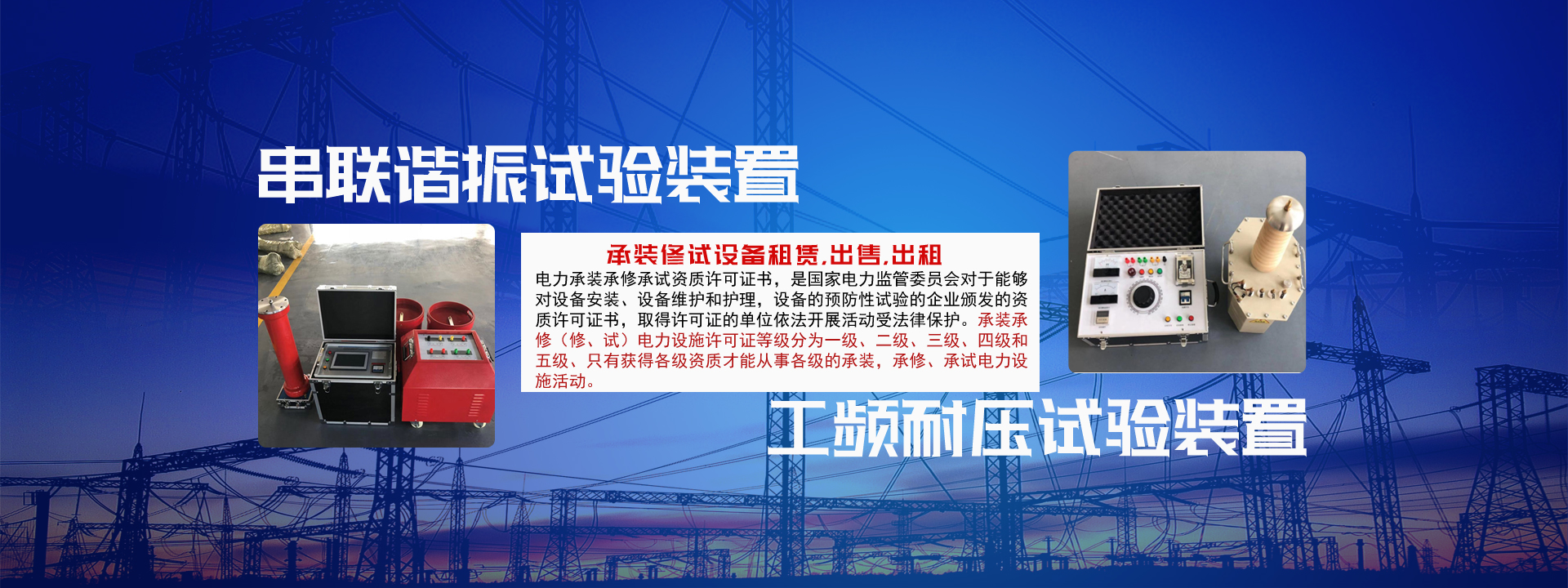
The principle of the variable frequency series resonance complete device is based on the series resonance principle. By adjusting the output frequency of the variable frequency controller, the reactor inductance L in the circuit and the test object capacitance C undergo series resonance, and the resonance voltage is the voltage applied to the test object. The power supply is provided by the variable frequency controller. After the test voltage is initially boosted by the excitation transformer, high voltage is applied to the reactor L and the test object Cx. By changing the output frequency of the variable frequency controller, the circuit is in a series resonance state, and the output voltage of the variable frequency controller is adjusted so that the high voltage on the test object reaches the required voltage value. The resonance frequency f=1/(2LC). The principle of the variable frequency series resonance complete device is based on the series resonance principle. By adjusting the output frequency of the variable frequency controller, the reactor inductance L in the circuit and the test object capacitance C undergo series resonance, and the resonance voltage is the voltage applied to the test object. The variable frequency resonance test device is widely used in industries such as electric power, metallurgy, petroleum, and chemical engineering. It is suitable for capacitive test objects with large capacity and high voltage, such as generators, power transformers, GIS, high cross-linked power cables, instrument transformers, bushings, etc., for commissioning tests and preventive tests. The variable frequency series resonance complete device mainly consists of a variable frequency controller, an excitation transformer, a high-voltage reactor, and a high-voltage voltage divider. The variable frequency controller is divided into two categories: those with 20KW and above are console type, and those below 20KW are portable box type; the variable frequency series resonance complete device consists of a controller and a filter. The main function of the variable frequency controller is to convert the fixed amplitude and frequency 380V or 200V power frequency sinusoidal AC into a sinusoidal wave with adjustable amplitude and frequency, and provide power for the entire equipment. The high-voltage reactor L is an important component of the resonance circuit. When the power frequency equals 1/(2LCX), it undergoes series resonance with the test object CX. 5. High resolution, frequency resolution is 0.001Hz, voltage resolution: coarse adjustment is 1%, fine adjustment is 0.01%. 6. High safety and reliability, the system has overvoltage, overcurrent, and discharge protection functions, which can protect the safety of personnel and equipment. User-side residual current electrical fire monitoring device image and electrical symbols, secondary system components: residual current electrical fire monitoring device. Main function: used to detect electrical parameters such as residual current and temperature in the system that may cause electrical fire hazards, and issue alarm and control signals. Overload monitoring device image and electrical symbols, secondary system components: overload monitoring device. Main function: by detecting the current of the line, it realizes two-stage alarm for overload of the distribution circuit. It is suitable for lines where sudden power outage causes greater losses than overload, and its overload protection acts on signals. The meaning of English letters on the frequency converter: 1. English meaning: In different modes, the functions of these keys are different. The following lists some of the same functions: First row: potentiometer. Controls the forward rotation of the frequency converter, and the corresponding indicator light will be on at this time. Third row: REV: reverse. Detailed explanation of the characteristics of series circuits and parallel circuits: 1. Series circuit: A circuit where conductors are connected end to end in sequence is called a series circuit. Characteristics of a series circuit: 1. Current: In a series circuit, the current is equal everywhere, that is, I=I1=I2=I3. 2. Voltage: The total voltage is equal to the sum of the voltages of each part, that is, U=U1+U2+U3. Knowledge about voltage series negative feedback circuits and current series negative feedback circuits, introducing the judgment method of voltage and current, the four ways of operational amplifier negative feedback circuits: parallel voltage feedback, series voltage negative feedback, series current feedback, parallel current feedback, etc. What types of frequency converter overvoltage alarms are there, and how to solve them? When using a frequency converter to control a fan, during stopping, the motor does not stop due to inertia and regenerative electricity occurs, causing the frequency converter to have an overvoltage alarm. How to solve it? Let's learn about it below. Measurement methods for RL series circuits: methods for measuring the DC resistance of inductors and measuring the voltage and current of RL series circuits, with a very detailed illustrated tutorial for reference. About the model of low-voltage dynamic reactive power compensation device, the structural characteristics of the low-voltage dynamic reactive power compensation device, and its functions in control and protection, including adaptation to harsh environmental conditions, suitable application fields, and corresponding load applications. What types of insulators are commonly used? According to the function of insulators in the line, and the structure of the insulators themselves, or classified by the material of the insulators, what are the types of insulators? Let's learn about them. ... [What is eddy current, what are the causes of eddy current] Some knowledge about eddy current, what is eddy current? Eddy current is the abbreviation of eddy current. The induced current in a conductor flows in a vortex shape, which is called eddy current. What are the causes of eddy current? ... Does the different length of wires affect the magnitude of current? There is no doubt about it. How much impact does the distance of wires have on current? What is the relationship between current changes in the circuit and load characteristics? Let's take a look. ... What technical skills should electricians master? Some formulas for electrician skills. Although being an electrician is good, you should know and be able to do the necessary things, be proficient in technical skills, and rely on practice. Remember rules and regulations, skills depend on practice, know the system and discipline, and serve with high management level. ... What is contact voltage? Contact voltage refers to the potential difference between the hand and the foot when a person stands next to a device with a ground fault, at a horizontal distance of 0.8 meters from the device, and touches the device shell with a hand. This potential difference is called contact voltage. ... Classification of filters: according to the processed signal, they are divided into analog filters and digital filters. Filters can also be classified by signal processing method, by components, by passband, by passband filtering characteristics, etc. ...

- Home
- About Us
- Products
- Series Resonance Test Device
- Power Frequency Withstand Voltage Device
- Electrical Characteristic Console
- High Current Generator
- Transformer Characteristic Test Bench
- Transformer Ratio Tester
- Triple Frequency Generator
- CT/PT Characteristic Tester
- Cable Fault Tester
- Dielectric Loss Tester
- Capacitance/Inductance Tester
- Partial Discharge Tester
- Microcomputer Relay Protection Tester
- ZnO Arrester Tester
- Transformer Capacity Characteristic Tester
- Company News
- Industry Trends
- Messages
- Contact Us
☎
Service Hotline18952707000