
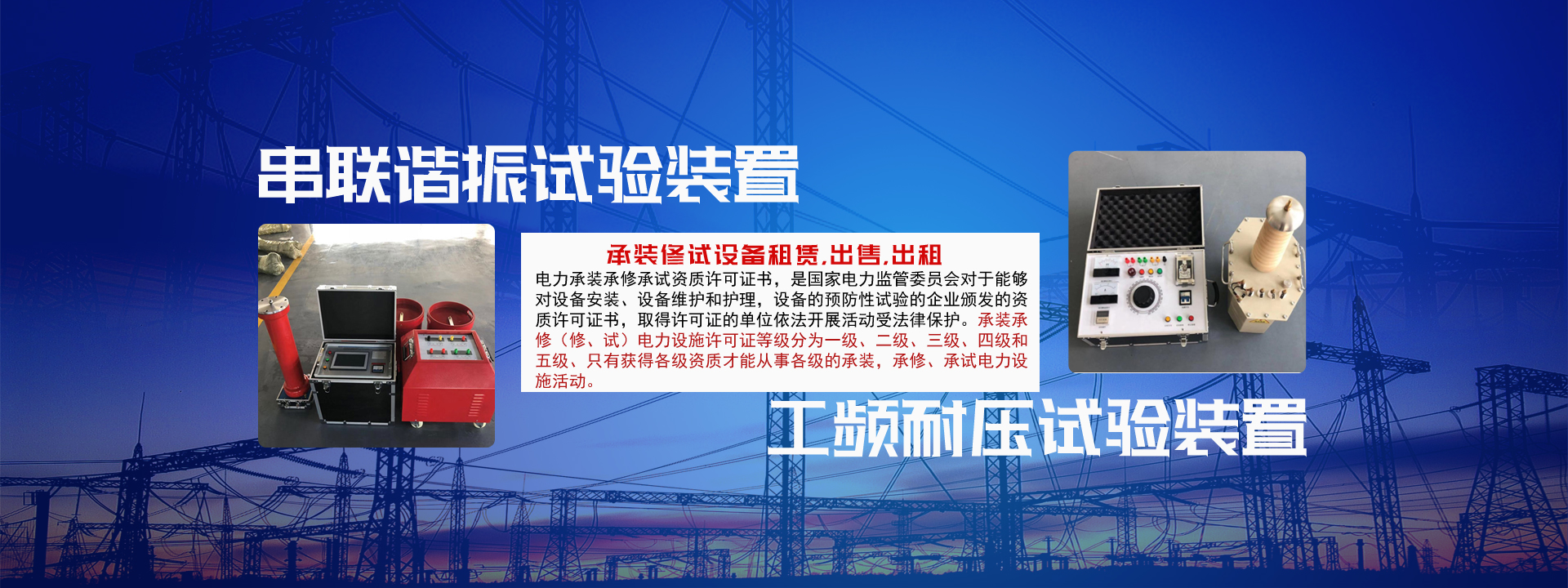
Specialized in the development, production, and sales of equipment for electric power installation, maintenance, and testing qualifications at levels 1, 2, 3, 4, and 5, including variable frequency series resonance test devices, circuit breaker testers, DC resistance testers, switch testers, loop resistance testers, relay protection testers, cable fault testers, insulation resistance testers, transformer testers, zinc oxide arrester characteristic testers, and transformer volt-ampere ratio and polarity comprehensive testers, as well as other electrical testing equipment, comprehensive automation of power systems, and intelligent instruments. We are a professional manufacturer of high-voltage testing equipment, dedicated to electrical measurement and serving the power industry!
2. AC withstand voltage test for electrical equipment such as 10kV switches, with test frequency of 30-300Hz, test voltage not exceeding 42kV, and test duration of 1 minute.
5. AC withstand voltage test for electrical equipment such as 35kV switches, with test frequency of 30-300Hz, test voltage not exceeding 95kV, and test duration of 1 minute.
1. The device has protection functions such as overvoltage, overcurrent, zero-position start, and system detuning (flashover). The overvoltage and overcurrent protection values can be set according to user needs. When the test object flashes over, the flashover protection acts and records the flashover voltage value for test analysis.
3. The device has three working modes: fully automatic mode, manual mode, and automatic tuning with manual boosting mode; it is convenient for users to flexibly choose according to on-site conditions, improving test speed.
5. When the device automatically sweeps frequency, the starting frequency can be arbitrarily set within the specified range, and the sweep direction can be selected upward or downward. At the same time, the large LCD screen displays the sweep curve, making it intuitive for users to see whether the resonance point is found.
6. Adopting DSP platform technology, functions can be added or upgraded according to user needs, and the human-machine interface is more user-friendly.
7. The required power supply capacity is greatly reduced. Series resonance power uses the resonance reactor and the capacitance of the test object to generate high voltage and large current. In the entire system, the power supply only needs to provide the active power consumption part, so the power required for the test is only 1/Q of the test capacity.
8. The weight and volume of the equipment are greatly reduced. In the series resonance device, the bulky high-power voltage regulation device and the ordinary high-power power frequency test transformer are omitted. Moreover, the resonance excitation power supply only needs 1/Q of the test capacity, which greatly reduces the system weight and volume, generally 1/10-1/30 of ordinary test devices.
9. Effectively improves the output voltage waveform. The resonance power supply is a resonant filter circuit, which can improve the waveform distortion of the output voltage, obtain a good sine waveform, and effectively prevent harmonic peaks from causing false breakdown of the test object.
10. Prevents large short-circuit currents from burning the fault point. When the insulation weak point of the test object is broken down, the circuit immediately detunes, and the loop current rapidly drops to 1/Q of the normal test current. However, when using parallel resonance or a test transformer for withstand voltage tests, the breakdown current immediately rises dozens of times. Comparing the two, the short-circuit current and breakdown current differ by hundreds of times. There is no worry of large short-circuit currents burning the fault point.
11. No recovery overvoltage will occur. When the test object breaks down, due to the loss of resonance conditions, the high voltage immediately disappears, and the arc extinguishes instantly. Moreover, the re-establishment process of the recovery voltage is very long, making it easy to disconnect the power supply before reaching the flashover voltage again. This voltage recovery process is an intermittent oscillation process of energy accumulation, which is long and does not produce any recovery overvoltage.
DL/T849.6-2004 "General Technical Conditions for Special Testing Instruments for Power Equipment Part 6: High Voltage Resonance Test Devices" Return to Sohu, see more