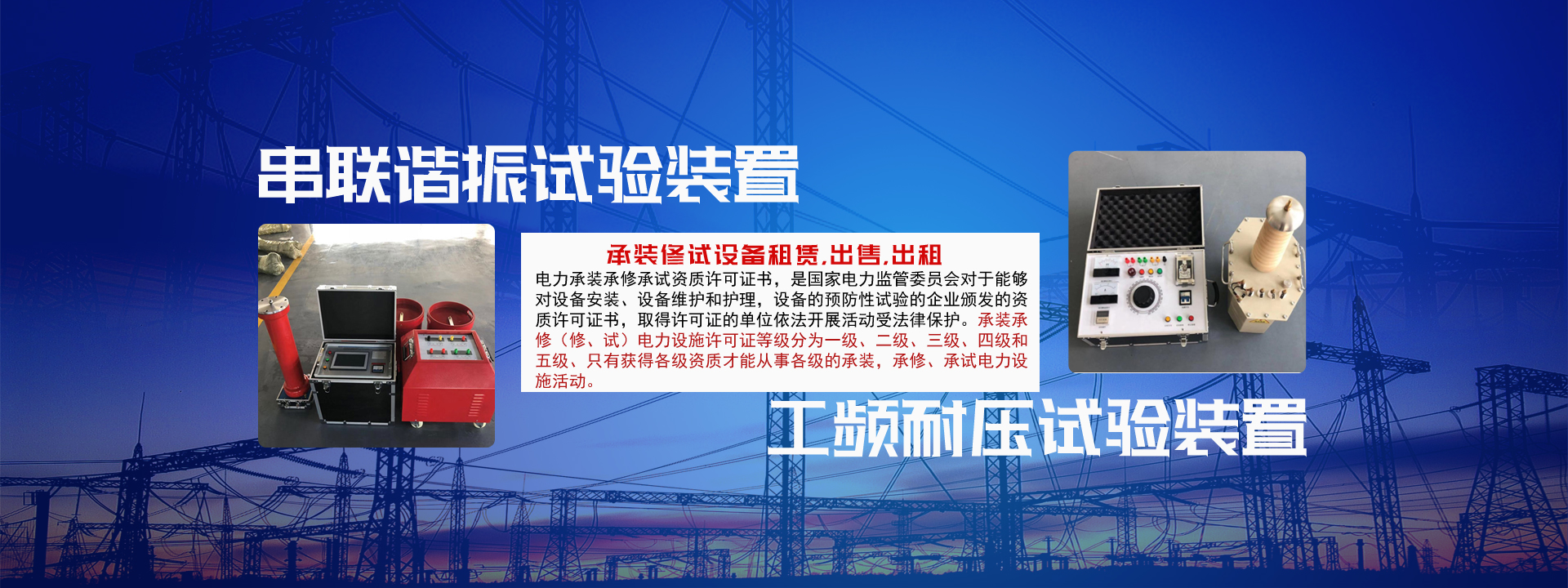
The status of the high current generator is as follows: test transformer outputs high voltage
According to the output current magnitude and structural form, it is mainly divided into: By current level: Small: 0~500A, portable, suitable for on-site CT calibration and small switch testing. Medium: 0~2000A, requires cart movement, suitable for distribution room busbar testing and medium circuit breaker testing. Large: 0~5000A ~ 20000A+, fixed or heavy-duty trailer, suitable for main busbar temperature rise testing in power plants and large substations, and rotor AC impedance testing for large generators. By control method: Manual: adjust the voltage regulator via handwheel, low cost, but slightly lower adjustment accuracy, suitable for simple tests. Electric/smart: panel buttons or remote control, automatic current rise, constant current control, with overcurrent protection, timing function, data can be printed/uploaded. 4. "Ecological relationship" with other instruments In the test system you build, the status of the high current generator is as follows: vs test transformer: Test transformer: outputs high voltage, small current (kV level, mA~A level), used to assess insulation strength (withstand voltage test). High current generator: outputs low voltage, high current (V level, kA level), used to assess conductive performance and thermal stability. Complementary: one tests "insulation", the other tests "conduction/heating", both are indispensable. vs DC resistance tester: The DC resistance tester measures static resistance at micro-ohm level. The high current generator applies dynamic AC high current, which can detect problems that DC resistance cannot (such as skin effect, poor contact heating under AC, magnetic circuit saturation effects, etc.). vs high-altitude wiring clamp: The output wires of the high current generator are usually very thick and stiff, and the current is huge. Using a high-altitude wiring clamp to safely and firmly connect it to high-altitude busbars or CT primary terminals is standard operating procedure. If contact is poor, high-temperature arcs will be generated instantly under high current, burning the equipment. 5. Key operating points and safety warnings (critical) Contact resistance is the biggest enemy: Since the output current is extremely large (e.g., 1000A), even if the contact point has only 0.001Ω contact resistance, it will generate

- Home
- About Us
- Products
- Series Resonance Test Device
- Power Frequency Withstand Voltage Device
- Electrical Characteristic Console
- High Current Generator
- Transformer Characteristic Test Bench
- Transformer Ratio Tester
- Triple Frequency Generator
- CT/PT Characteristic Tester
- Cable Fault Tester
- Dielectric Loss Tester
- Capacitance/Inductance Tester
- Partial Discharge Tester
- Microcomputer Relay Protection Tester
- ZnO Arrester Tester
- Transformer Capacity Characteristic Tester
- Company News
- Industry Trends
- Messages
- Contact Us
☎
Service Hotline18952707000