(1) Test personnel should divide the work and clarify mutual methods. There should be a dedicated person to monitor the safety of the site and observe the condition of the test object.
(2) The test object should be cleaned and absolutely dry to avoid damage to the test object and errors in the test.
(3) For large-scale tests, a no-load test should generally be conducted first. That is, without connecting the test object, raise the voltage to the test voltage, calibrate various meters, and adjust gaps.
(4) The voltage raising speed should not be too fast, and sudden pressurization must be prevented. For example, sudden closing when the voltage regulator is not at zero position, and sudden cutting off of the power supply should also be avoided. Generally, the power should be cut off after the voltage regulator is lowered to zero.
(5) When the voltage rises to the test voltage, start timing. After 1 minute, only when it quickly drops below 1/3 of the test voltage can the power be turned off.
(6) During the voltage raising or withstand voltage test, if any of the following abnormal conditions are found, the voltage should be immediately reduced, the power cut off, the test stopped, and the cause investigated: ① The voltmeter pointer swings greatly; ② Insulation burning smell or smoke is found; ③ Abnormal sounds inside the test object.
(7) Before and after the withstand voltage test, the insulation resistance should be measured to check the insulation condition.
Operation and precautions for leakage test
(1) Before the test, check whether the test object is de-energized, grounded and discharged, and whether all external connections are clean. Strictly prevent the test voltage from being applied to the working parts of personnel.
(2) After connecting the test device wiring, it should be rechecked for correctness before applying voltage. Special attention should be paid to checking the safe distance between high-voltage equipment and leads, and the ground and operating personnel, and whether the casing of the test object is reliably grounded. The test should be carried out according to the contents specified in the safety regulations.
Technical Parameters:
◆ Power supply voltage: AC220V ±10%, 50Hz±1 Hz
◆ Input current: 0 ~ 25A
◆ Meter voltage: 0 ~ 100V (other ranges can be customized)
◆ Output voltage: 0 ~ 250V
◆ Output current: 0 ~ 20A
◆ Voltage measurement accuracy: 0.5 %FS ±3 digits
◆ Current measurement accuracy: 0.5 %FS ±3 digits
◆ Timing length: 0 ~ 9999 S (special modes can work for long periods)
◆ Operating environment: ambient temperature 0~50 ℃ relative humidity ≤85 RH
Product Introduction
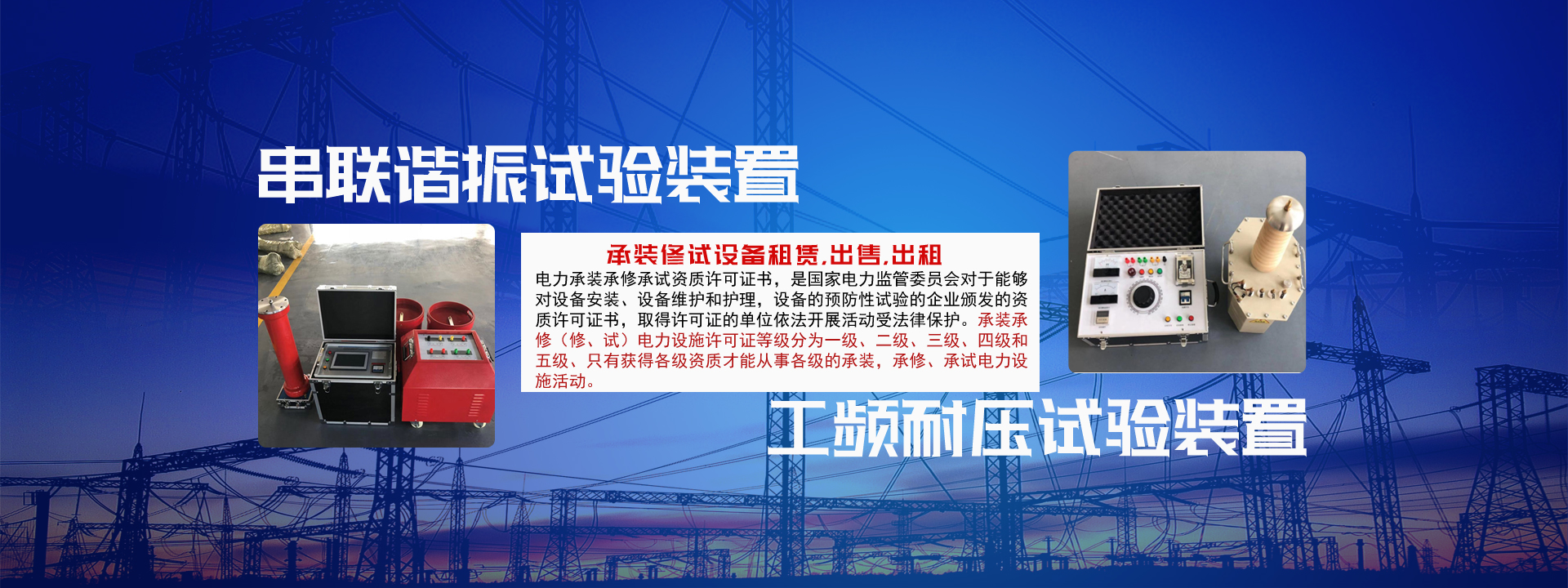
The 3kVA/50kV power frequency withstand voltage test device is professionally manufactured with touch-type button operation. All functions can be set via buttons, improving the safety and reliability of the product; the all-digital calibration method abandons the outdated potentiometer adjustment, making field use extremely convenient and accuracy easy to control (this function is password protected)
Note: The above information and technical parameters are compiled and released by Yangzhou Darui Electric Co., Ltd.