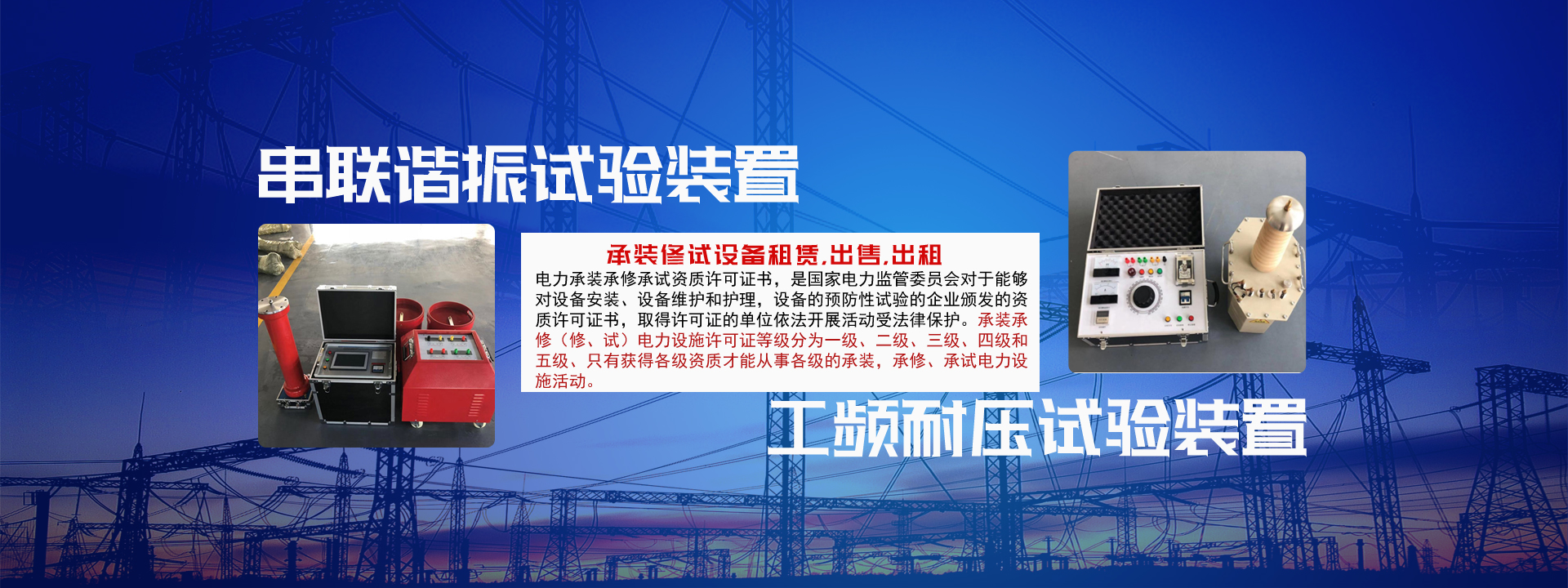
3KVA/50KV Oil-immersed Test Transformer
Darui Electric recommends
Technical Parameters:
1. Source voltage: ~220V±10% 50HZ
2. Maximum rated output capacity: 1KVA
3. Adjustable AC current output: 0—~100A (~7.5V) 0—50A (~15V)
4. Adjustable AC voltage output: 0—~440V (~2.5A) 0—~220V (5A)
0—~100V (20A)
5. Adjustable DC voltage output: 0— -110V (8A) 0— -350V (3A)
6. Current and voltage meters can display data for each gear (0—50A and 0—100A gears require external standard ammeter.)
7. Time test range: 0—19.999S
Capacity Selection:
The formula for determining the nominal test transformer capacity Pn: Pn=KVn2ωCt×10-9
Where: Pn----Nominal test transformer capacity (kVA)
Vn-----Rated output high voltage RMS value of the test transformer (kV)
K------Safety factor. K≥1, when nominal voltage Vn≥1MV, K=2, when nominal voltage is lower, K value can be higher.
Ct-----Capacitance of the test object (PF)
ω----Angular frequency, ω=2πf, f----Frequency of the test power supply
The capacitance Ct of the test equipment can be measured by an AC bridge. Ct varies greatly and can be determined by the type of equipment. Typical data are as follows:
Simple bridge or suspension insulators: tens of microfarads
Simple graded bushings: 100 – 1000PF
Voltage transformers: 200 – 500PF
Power transformers: < 1000kVA - 1000PF
> 1000kVA 1000 – 10000PF
High-voltage power cables and oil-impregnated paper insulation: 250 – 300PF/m
Gas insulation: - 60PF/m
Enclosed substations, SF6 gas insulation: 100 – 10000PF
For different test voltages Vn, select different (appropriate) safety factors K. The K values for different Vn listed above are for reference.
Vn = 50–100kV K=4
Vn = 150–300kV K=3
Vn > 300kV K=2
Precautions:
1. DC leakage test operation process
(1) Test personnel should divide responsibilities, set up a safe distance at the test site, carefully check the grounding of the test object and test transformer, and assign dedicated personnel to monitor safety and observe the status of the test object.
(2) Before testing, all external connections should be removed, and the test object should be fully discharged. The main parts should be cleaned and kept absolutely dry to avoid damage to the test object and errors in test values.
(3) For large-capacity test objects (capacitors, extra-long cables, etc.), the voltage should be raised slowly during the test to prevent the charging current from being too large and burning out the microammeter. If necessary, pressurize in stages and read the stable readings of the microammeter at each voltage level.
(4) During the test, closely monitor the test object, microammeter, and test device. If any flashover, breakdown, or other phenomena occur, immediately reduce the voltage, cut off the power, and investigate the cause.
2. Power frequency withstand voltage test operation process
1. Test personnel should divide responsibilities, set up a safe distance at the test site, carefully check the grounding of the test object and test transformer, and assign dedicated personnel to monitor safety and observe the status of the test object.
2. The main parts of the test object should be cleaned and kept absolutely dry to avoid damage to the test object and errors in test values.
3. For tests on large equipment, a no-load test of the test transformer should generally be performed first, i.e., raising the voltage to the test voltage without connecting the test object, to calibrate the indication accuracy of the instruments and adjust the gap distance of the discharge ball gap.
4. During the withstand voltage test, the voltage raising speed should not be too fast, and sudden pressurization should be prevented, such as sudden closing of the switch when the voltage regulator is not at zero position. Also, sudden power-off should be avoided. Generally, the switch should be opened after the voltage regulator is lowered to zero.
5. During the voltage raising or withstand voltage test, if any abnormal conditions are found: 1. The voltage and current meter pointers swing greatly, 2. The test object emits abnormal sounds, 3. Insulation is found to be burnt or smoking, immediately reduce the voltage, cut off the power, stop the test, and investigate the cause.
Product Introduction
Widely used in electrical manufacturing departments, power operation departments, scientific research institutions, and universities. The power frequency withstand voltage test device is divided into integrated devices (below 30kV) and split devices. It works by connecting to a 220V or 380V power frequency power supply, adjusting the voltage regulator (i.e., the input voltage of the test transformer), and connecting it to the primary winding of the high-voltage test transformer. According to the principle of electromagnetic induction, the required high voltage test value is obtained. According to test regulations, various large power transformers, power cables, steam and hydro generators, and other capacitive equipment must undergo regular AC withstand voltage tests.
Note: The above information and technical parameters are compiled and released by Yangzhou Darui Electric Co., Ltd.

|