
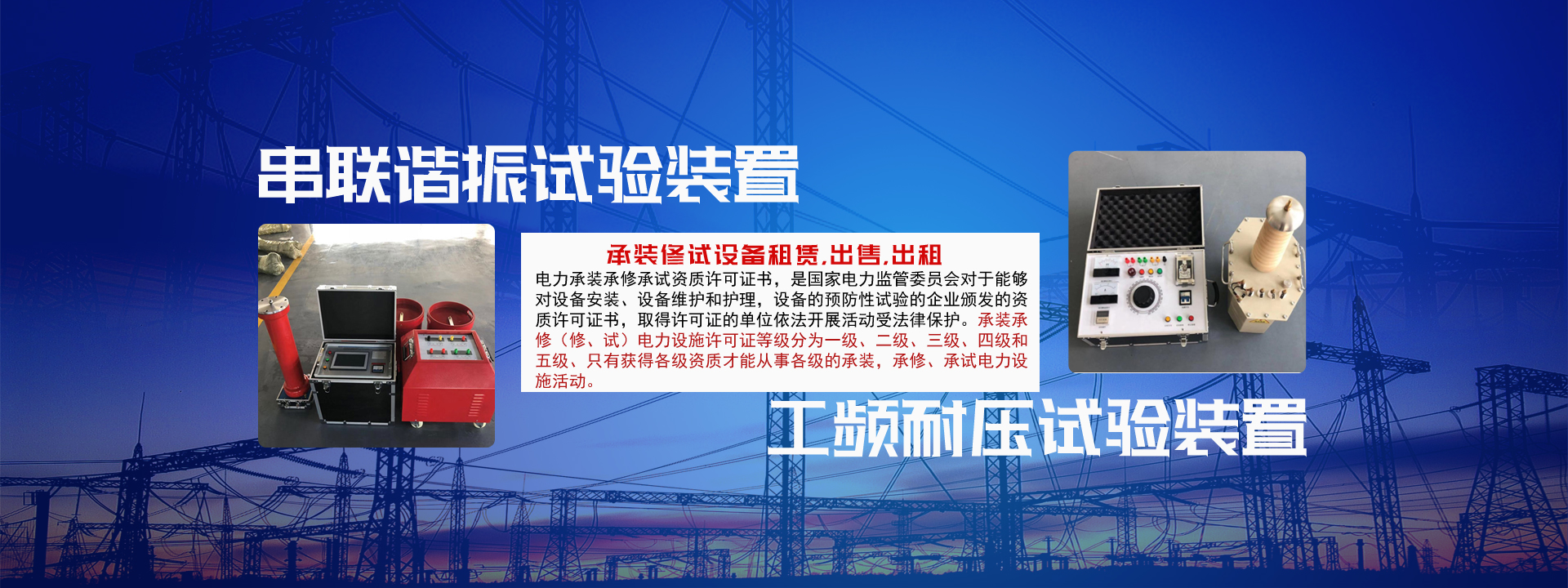
In order to prevent high-voltage electrical equipment from being damaged or experiencing accidents during operation, and to ensure the personal safety of operation and maintenance personnel as well as the safe operation of equipment, it is necessary to inspect and assess the health status of equipment through insulation handover tests and preventive tests. Through high-voltage testing, we can understand the insulation level of equipment and eliminate blind spots in equipment defects. If insulation defects are found during testing, it indicates that we must repair the equipment and, if necessary, replace the electrical equipment to prevent insulation breakdown during operation, thereby avoiding major irreversible losses such as power outages.
Generally speaking, high-voltage electrical tests are mainly divided into preventive tests and handover tests. Based on equipment classification, they mainly include: transformer testing, voltage transformer testing, current transformer testing, lightning arrester testing, circuit breaker testing, power cable testing, high-voltage busbar testing, and high-voltage motor testing. For different equipment, tests should be strictly conducted according to the specified test items and contents in the regulations. Among them, the insulation withstand voltage test is a fundamental and important electrical test.
Preventive tests can be divided into two types: one is the insulation characteristic test, which is a non-destructive test. By measuring various characteristic parameters such as insulation resistance, dielectric loss tangent, leakage current, etc., it determines whether there are defects inside the equipment insulation. This test requires lower voltage conditions and does not damage the internal insulation of the equipment. This type of insulation characteristic test is very effective, but it cannot solely and effectively judge the insulation electrical strength, which is a drawback of this test.
The other is the withstand voltage test, which is a destructive test. During the test, a high voltage is applied to the equipment, exceeding its working voltage. This poses a significant challenge to the equipment insulation and can detect some highly dangerous defects and some concentrated defects, while ensuring that the insulation electrical strength reaches a certain level. However, this can cause a certain degree of damage to the insulation. The withstand voltage test is further divided into AC withstand voltage and DC withstand voltage, and its drawback is that it causes some damage to the insulation. Both types of tests have their own advantages, and appropriate tests should be selected based on actual conditions and needs.