
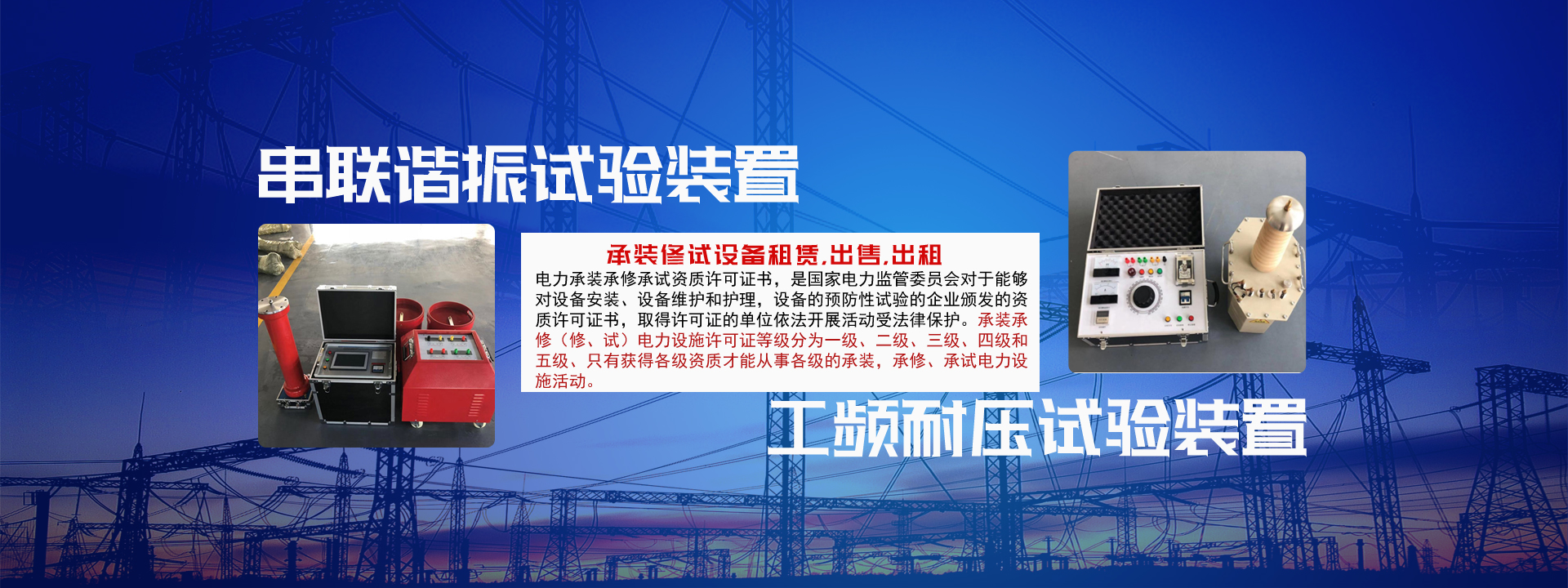
Preventive tests on high-voltage test transformers refer to the periodic inspections or tests conducted on equipment already in operation according to specified test conditions (such as specified test equipment, environmental conditions, test methods, and test voltages), test items, and test cycles, in order to detect hidden dangers in power equipment during operation, prevent accidents or damage to power equipment. It is an important measure to determine whether power equipment can continue to be put into operation and ensure safe operation.
This can be carried out through the following aspects:
1. Measuring insulation resistance
A common and simple test method, usually measured with a megohmmeter. Based on the insulation resistance value of the test object measured at 1 minute, it can detect whether the insulation has through-type concentrated defects, overall dampness, or through-type dampness.
2. Measuring leakage current
Its principle is basically the same as measuring insulation resistance, and the nature of detected defects is also roughly the same. However, since the power supply used in leakage current measurement is generally provided by high-voltage rectification equipment, and the leakage current is directly read with a microammeter, it has the characteristics of adjustable test voltage, high sensitivity, good measurement repeatability, conversion to insulation resistance value, and the ability to judge insulation defects by measuring the absorption ratio.
3. Measuring dielectric loss angle
As a highly sensitive test item, it can detect overall dampness, deterioration, aging, and local defects (whether through or not) in small-volume test objects. However, when the test object is large and the defect occupies a relatively small volume, this method may not be effective. It is widely used in electrical manufacturing and in handover and preventive tests of electrical equipment.
4. AC withstand voltage test
One of the destructive tests, it can further diagnose insulation defects in electrical equipment. The AC withstand voltage test is a strict, effective, and direct test method for identifying the insulation strength of electrical equipment. It can detect weaknesses in insulation during normal operation and plays a decisive role in determining whether electrical equipment can continue to be put into operation.
5. DC withstand voltage test
In addition to detecting insulation dampness and deterioration, it has a special role in detecting certain local defects in insulation. The DC withstand voltage test can detect defects that some AC withstand voltage tests cannot. These two tests (AC and DC) cannot replace each other and must be applied simultaneously in preventive tests, especially for motors, cables, etc., where DC withstand voltage tests should be performed.
6. Non-destructive tests and destructive tests
① Non-destructive tests: These are conducted at lower voltages (below or close to rated voltage). Among them, measuring insulation resistance, leakage current, and dielectric loss angle are non-destructive tests.
② Destructive tests: These are tests conducted at voltages higher than the working voltage, also known as withstand voltage tests. During the test, a specified test voltage is applied to the insulation of electrical equipment to test its withstand capability under this voltage. Both DC withstand voltage tests and AC withstand voltage tests are destructive tests.
There is a certain order for these two types of tests: non-destructive tests should be conducted first, followed by destructive tests, to avoid unnecessary breakdown accidents.