
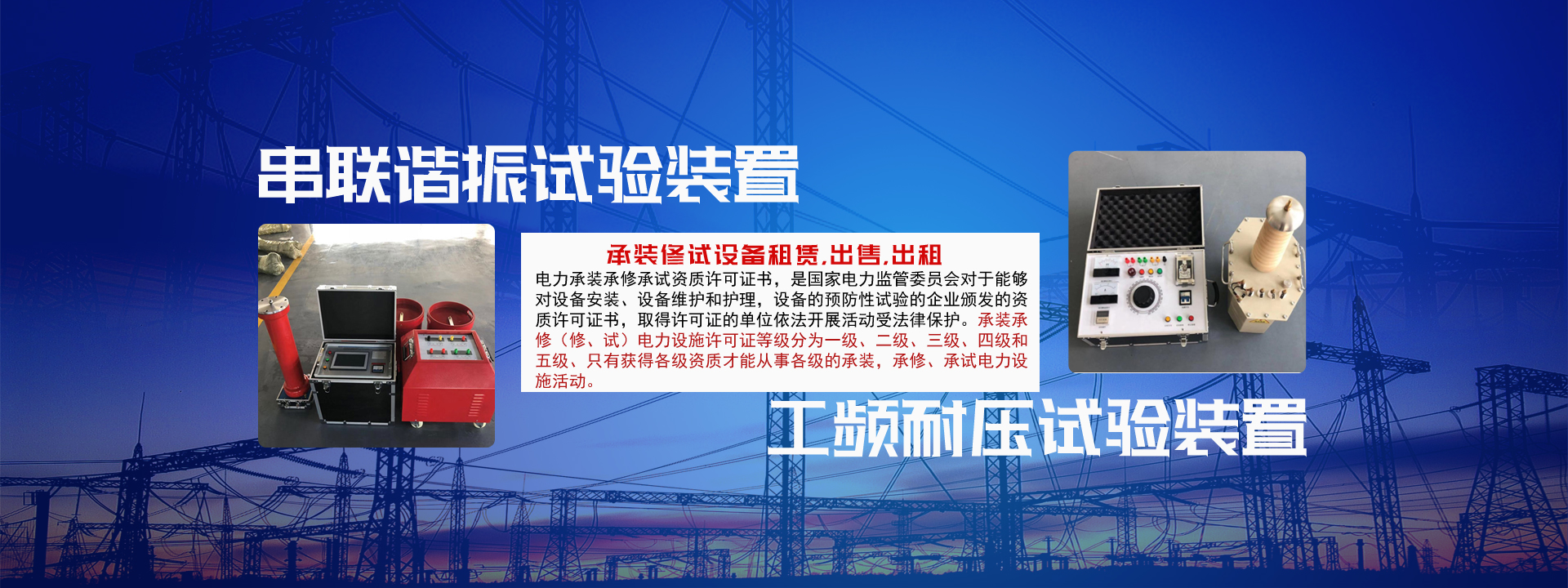
Dary Electric recommends
1. General Precautions
(1) This test equipment should be used by professional high-voltage test personnel. Before use, carefully read the instruction manual and undergo repeated operation training.
(2) At least two operators are required. During use, strictly comply with the safety operation regulations for high-voltage tests in your unit.
(3) To ensure the safety and correctness of the test, in addition to being familiar with this product manual, you must strictly follow relevant national standards and regulations for test operations.
(4) All connection wires must not be connected incorrectly; otherwise, the test device may be damaged.
(5) When this device is in use, it outputs high voltage or ultra-high voltage. It must be reliably grounded, and attention should be paid to operational safety.
2. Common Fault Causes and Troubleshooting
(1) Fan fails to start:
① After emergency stop, fault protection, or detuning protection, the "fault reset" has not been pressed;
② Internal temperature is too high, and power components have thermal protection;
Troubleshooting: Turn off the instrument power, let it sit for about 30 minutes, then turn on the power again, press the "Reset" button on the instrument panel, and then start the instrument.
If the fan still cannot start, please contact the manufacturer. Do not disassemble the instrument!
3. Automatic tuning cannot be completed, and no resonance point is found:
Phenomenon: The tuning curve is completely a straight line, and after tuning is completed, the instrument prompts that there is no resonance point.
Cause: Poor grounding of the circuit, incorrect wiring of the test circuit, or an open circuit in a certain instrument of the device.
Troubleshooting:
(1) Check that the grounding device is reliable and whether there is a break in the grounding connection wire;
(2) Check the continuity of the high and low voltage coils of the excitation transformer;
(3) Check the continuity of each reactor;
(4) Check the continuity of the signal wire of the voltage divider;
(5) Check the continuity of the high and low voltage capacitor arms of the voltage divider;
(6) When the device itself boosts voltage without a resonance point, also check the continuity of the compensation capacitor;
If all components are normal and there is still no resonance point, please contact the manufacturer. Do not disassemble the instrument!
4. Cannot boost to the test voltage
Phenomenon:
(1) The tuning curve is a curve with a lower peak;
(2) During the test, the primary voltage is high, but the high voltage is low, and even before reaching the test voltage, the
(3) primary voltage has already reached the rated voltage, and the circuit automatically reduces voltage;
Cause:
(1) The reactor and the test object capacitance do not match, and the resonance point is not accurately found;
(2) The loss of the test object is high, and the system Q value is too low;
(3) The high voltage output of the excitation transformer is low;
(4) The high-voltage connection wire is too long or a high-voltage anti-corona wire is not used.
Troubleshooting:
(1) Connect the compensation capacitor in parallel to the test circuit to increase the circuit capacitance;
(2) Connect as many reactors in series as possible to increase the circuit inductance;
(3) Increase the output voltage of the excitation transformer;
(4) Dry the test object to improve its insulation strength and reduce active power loss in the circuit;
(5) Generally, when the device outputs higher voltage, use high-voltage anti-corona wires, or change the ordinary high-voltage output wire to a shorter connection, generally not exceeding 5 meters.
5. When protection occurs during withstand voltage test
(1) Increase the protection voltage value;
(2) Try not to use generator power supply. If there is no power source, use a high-power generator. Now you understand how to handle common faults in electrical test equipment.
Note: The above information and technical parameters are compiled and released by Yangzhou Dary Electric Co., Ltd.