
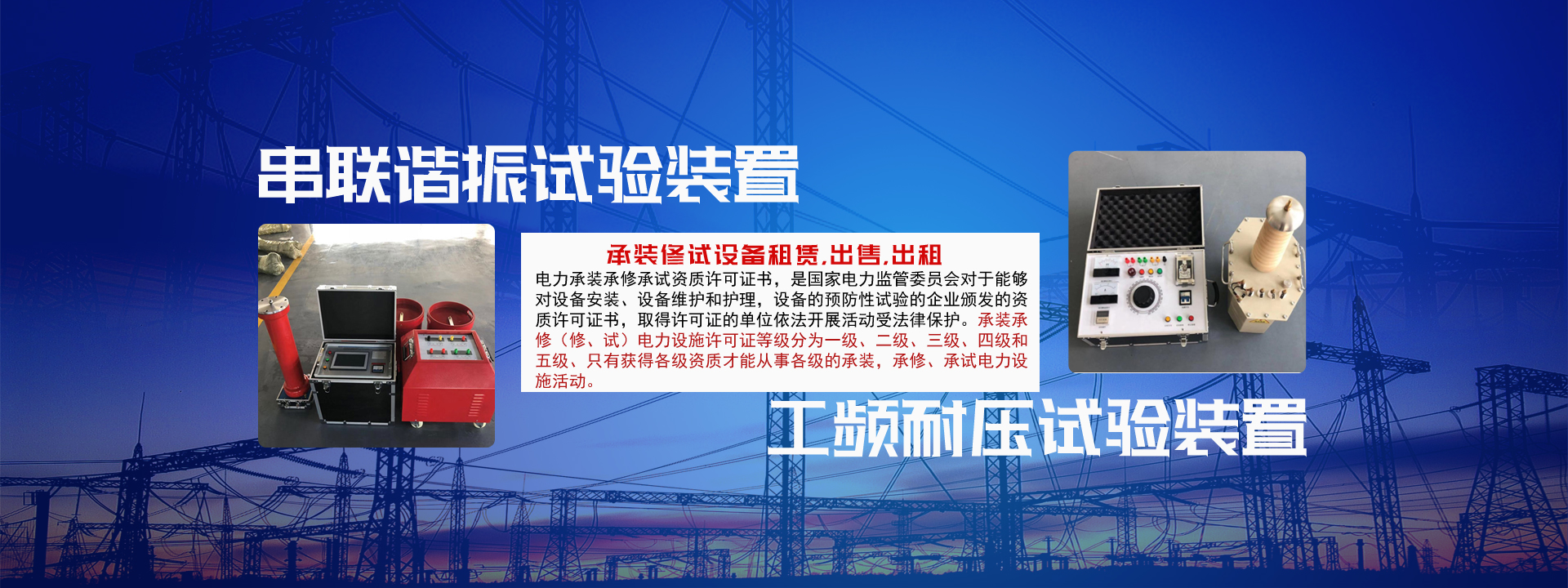
In recent years, the use of variable frequency series resonance for AC withstand voltage testing has become the most common test method for insulation inspection of high-voltage equipment in substations, and this test device has been widely applied. Due to the fact that this equipment is a complete set with many components, multiple usage scenarios, multiple tap voltages of the excitation transformer, and multiple combinations of reactors, customers often find it difficult to use proficiently on site. Today, we will discuss common problems and solutions with everyone, hoping to be helpful. The SXBP series resonance device operates on the principle of series resonance, generating resonance voltage in the circuit to be applied to the test object. Currently, series resonance devices are divided into two categories: variable frequency type and variable inductance type. They are composed of high-voltage reactors, adjustable reactors (variable inductance type), capacitive voltage dividers, and excitation transformers. They are widely used for commissioning and preventive tests of large-capacity, high-voltage capacitive test objects such as power cables, power transformers, and GIS. The SXTG variable inductance resonance mainly consists of a control box (power frequency), excitation transformer, adjustable reactor (variable inductance type), fixed reactor, and voltage divider. It is mainly used for generator tests with frequency requirements. The SXBP series resonance device has advantages such as small required power supply capacity, small equipment weight and size, improved output waveform, prevention of short-circuit current burns, and no recovery overvoltage. It fully meets the requirements of all indicators in the GB50150-2012 and DL/T849.6-2004 standards. 1) Check that the grounding device is reliable and the grounding connection line is intact; 2) Check the high and low voltage lines of the excitation transformer; 3) Check the continuity of each reactor; 1) The tuning curve is a curve; 2) During the test, the primary voltage is high, but the high voltage is low, and even before the test voltage is reached, the primary voltage has already reached the rated voltage, causing the circuit to automatically reduce voltage; 4) The high-voltage connection line is too long or does not use a high-voltage corona-resistant wire; 5) The reactor is too close to the ground or metal, generating large eddy currents. 1) Replace with an air switch with a larger current (or temporarily disconnect the leakage protection); 2) Check whether the resonant system circuit is short-circuited. Statement: This article only represents the author's personal views. Sohu Hao is an information publishing platform, and Sohu only provides information storage space services.
Rated impulse withstand voltage