
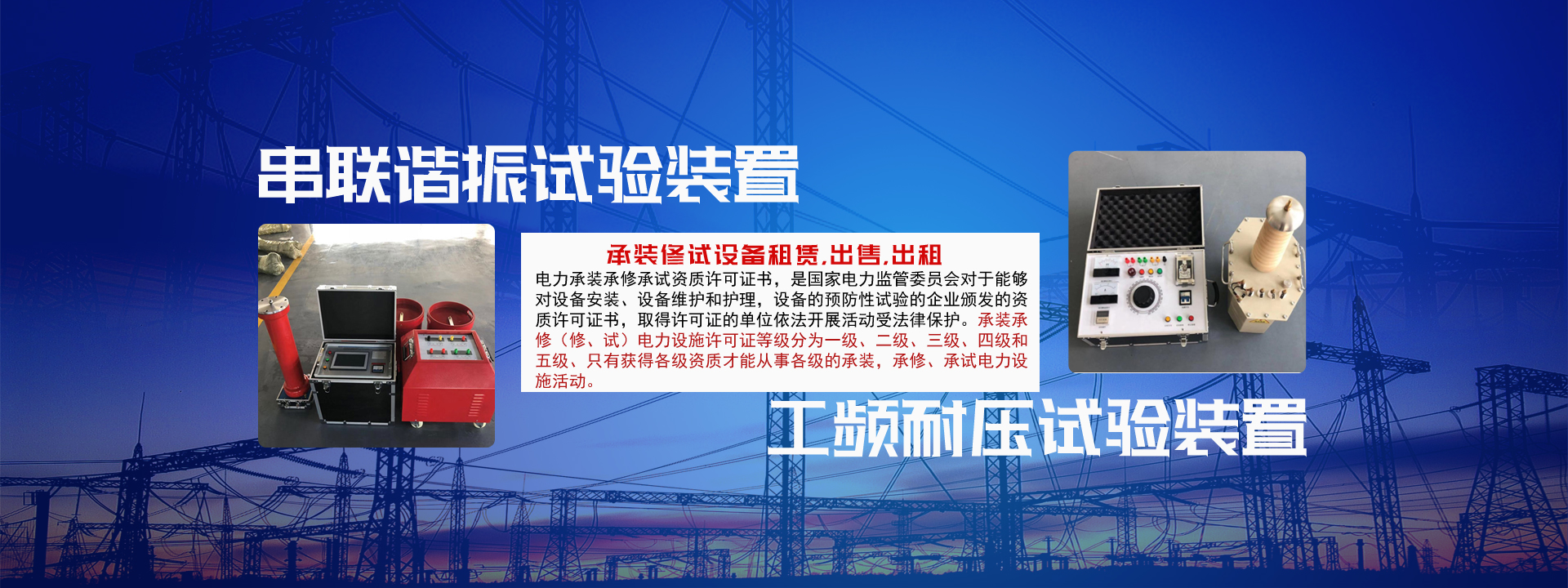
Transformers are one of the core equipment in power systems, and their operating condition directly affects the safety and stability of the power grid. Partial Discharge (PD) refers to the phenomenon of local electrical discharge that occurs in insulating materials when the electric field strength reaches a certain threshold. Although the energy of this phenomenon is not large, its long-term presence can accelerate insulation aging and ultimately lead to serious faults. Therefore, regular partial discharge testing of transformers is crucial. This article will introduce the basic principles, testing methods, and the important role of transformer partial discharge testers in power system maintenance.
Basic Principles of Partial Discharge Testers
A partial discharge tester is a specialized device used to detect partial discharge phenomena inside power equipment. It detects by capturing electromagnetic radiation, acoustic waves, or other physical phenomena generated by partial discharge. Common detection methods include:
Pulse Current Method (PCM): The current pulse generated by partial discharge is introduced into a detection impedance through a coupling capacitor, and then converted into a voltage signal for measurement.
Acoustic Emission (AE): Ultrasonic sensors are used to receive acoustic wave signals generated during partial discharge.
Transient Earth Voltages (TEV): Sensors placed on metal enclosures detect transient voltages generated by partial discharge.
Ultra High Frequency (UHF): UHF sensors installed inside or outside the transformer capture electromagnetic wave signals generated by partial discharge.
The Importance of Partial Discharge Testing
Early Warning: Partial discharge testing can promptly detect minor defects in insulating materials, helping to prevent potential serious faults.
Maintenance Planning: Data collected through regular testing can help formulate more reasonable maintenance plans and reduce unplanned downtime.
Cost-Effective: Compared to the repair costs after an accident, the cost of partial discharge testing is lower, offering higher economic benefits.
Testing Steps
Preparation: Ensure that the testing equipment is properly grounded and all necessary sensors and test lines are connected.
Calibration: Before formal testing, the testing system needs to be calibrated using a calibration pulse generator to ensure the accuracy of measurement results.
Adjust Gain: Adjust the amplifier gain according to the actual situation so that the injected pulse height is moderate, typically about 2 centimeters on the oscilloscope screen.
Start Testing: Slowly increase the test voltage until partial discharge phenomena are observed. The voltage at this point is the partial discharge inception voltage.
Data Analysis: Record the characteristic parameters of partial discharge, including the number and amplitude of discharge pulses, and conduct a comprehensive analysis.
Conclusion
Transformer partial discharge testers are indispensable tools in power equipment maintenance. They help engineers promptly detect and address potential insulation issues, thereby ensuring the safe and stable operation of power systems. With technological advancements, future testers will become more intelligent and portable, further improving testing efficiency and accuracy.