
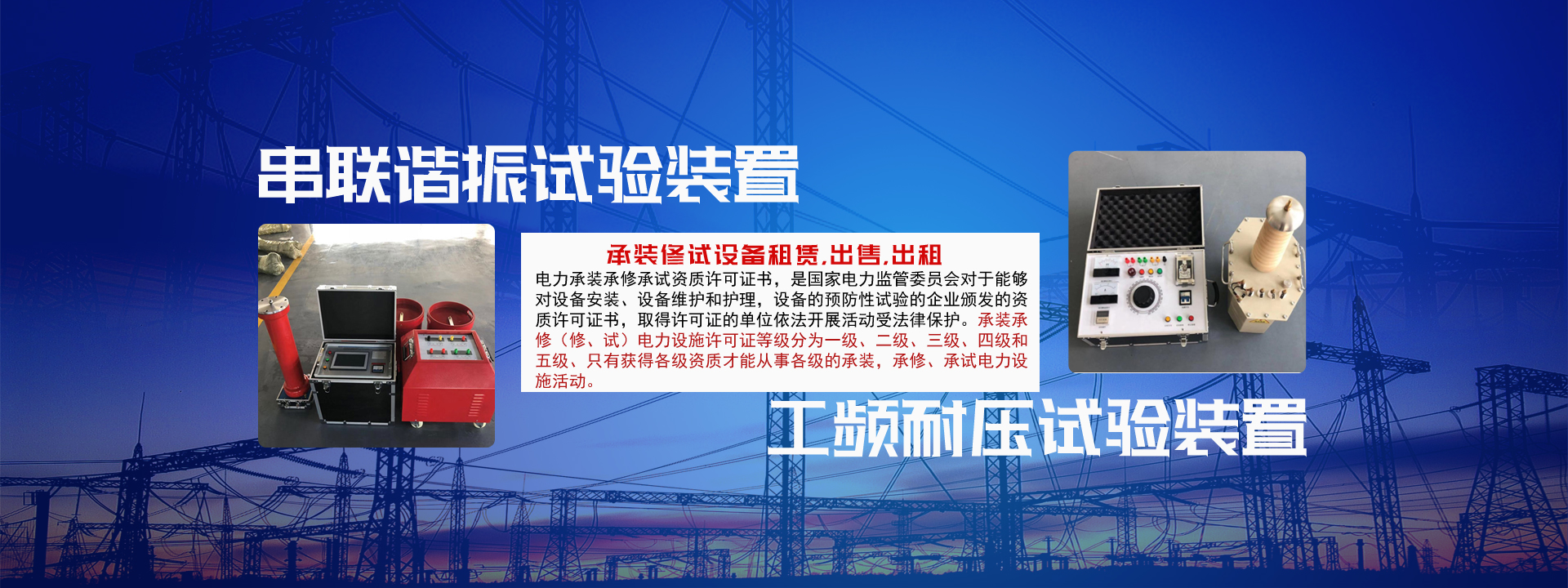
A series resonance test device is a specialized equipment used for insulation withstand voltage testing of high-voltage electrical equipment. It generates high-voltage alternating current under resonance conditions to test the insulation performance of electrical equipment, ensuring its safety and reliability in actual operation. This article will provide a detailed introduction to the working principle, main functions, application scenarios, and importance of the series resonance test device in the power system.
Working Principle
The series resonance test device utilizes a series resonant circuit composed of an inductor (L) and a capacitor (C) to produce a resonance state at a specific frequency, thereby generating high voltage under a smaller excitation power supply. This high voltage can be used to simulate the voltage conditions that electrical equipment may encounter in actual operation, testing the insulation performance of the equipment.
Basic Circuit Structure: The series resonance test device typically includes an adjustable frequency power supply, a step-up transformer, an inductor (such as a series reactor), a device under test (capacitive load), and measurement and protection devices.
Resonance Condition: When the circuit frequency
, the circuit enters a resonance state. At this point, the energy exchange between the inductor and capacitor reaches its maximum, resulting in high voltage across the device under test.
Voltage Amplification Effect: In the resonance state, the ratio between input voltage and output voltage depends on the inductor
C value, theoretically achieving very high voltage gain.
Main Functions
Insulation Withstand Voltage Test: Tests the insulation performance of electrical equipment by generating high voltage.
Adjustable Frequency: The test frequency can be adjusted according to the characteristics of different equipment to achieve the best test results.
Protection Functions: Equipped with various protection functions such as overvoltage, overcurrent, and overheat to ensure test safety.
Data Recording and Analysis: Some advanced devices are equipped with data recording and analysis functions for later evaluation of equipment condition.
Easy Operation: Features a user-friendly interface for easy setting and control of test parameters.
Application Scenarios
Series resonance test devices are widely used in testing high-voltage electrical equipment in the power system, including but not limited to:
Power Transformers: Conducting withstand voltage tests on transformers to ensure their insulation performance meets requirements.
High-Voltage Cables: Testing the insulation performance of high-voltage cables to ensure their safety during operation.
GIS Switchgear: Conducting withstand voltage tests on GIS (Gas Insulated Switchgear) to verify insulation reliability.
Power Capacitors: Testing the insulation performance of power capacitors to ensure their normal operation.
Instrument Transformers: Conducting withstand voltage tests on current transformers and voltage transformers to ensure reliable operation.
Usage Method
Preparation: Ensure the device under test is de-energized and connect the test device.
Set Parameters: Set test frequency, voltage, and other parameters according to the characteristics of the device under test.
Start Test: Start the test device and gradually increase the voltage until reaching the predetermined value.
Observation and Recording: Monitor the device's reaction under high voltage and record relevant data.
Result Analysis: Analyze the insulation performance of the device based on test results, and perform maintenance or replacement if necessary.
Practical Application Case
In a withstand voltage test of a transformer at a power company, technicians used a series resonance test device to conduct a withstand voltage test on a newly manufactured transformer. By adjusting the test frequency, technicians found that the transformer resonated at a certain frequency, causing the test voltage to reach the expected high voltage level. After a series of tests, it was ultimately confirmed that the transformer's insulation performance met standard requirements and could be safely put into use.
Technical Development and Trends
With the development of the power system and technological progress, series resonance test devices are continuously being improved and innovated:
Intelligence: Modern series resonance test devices are typically equipped with advanced computer control systems that can automatically complete test procedures and provide fault diagnosis suggestions through data analysis.
Portability: Some portable series resonance test devices have been introduced, allowing for rapid testing on-site and improving work efficiency.
Multi-functional Integration: New test devices integrate multiple test functions, enabling one-stop completion of multiple test tasks, reducing equipment footprint and cost.
Remote Monitoring: Through network technology, series resonance test devices can achieve remote monitoring and data transmission, facilitating centralized management of testing work at multiple locations.
Conclusion
The series resonance test device is one of the indispensable tools in the detection and maintenance of power systems. By simulating high-voltage conditions in actual operation, it can effectively evaluate the insulation performance and reliability of electrical equipment. With technological advancements, future test devices will become more intelligent and convenient, providing more support for the maintenance of power systems. Through regular testing and maintenance, not only can the reliability of the power system be improved, but also the losses caused by power outages due to electrical equipment failures can be significantly reduced.