
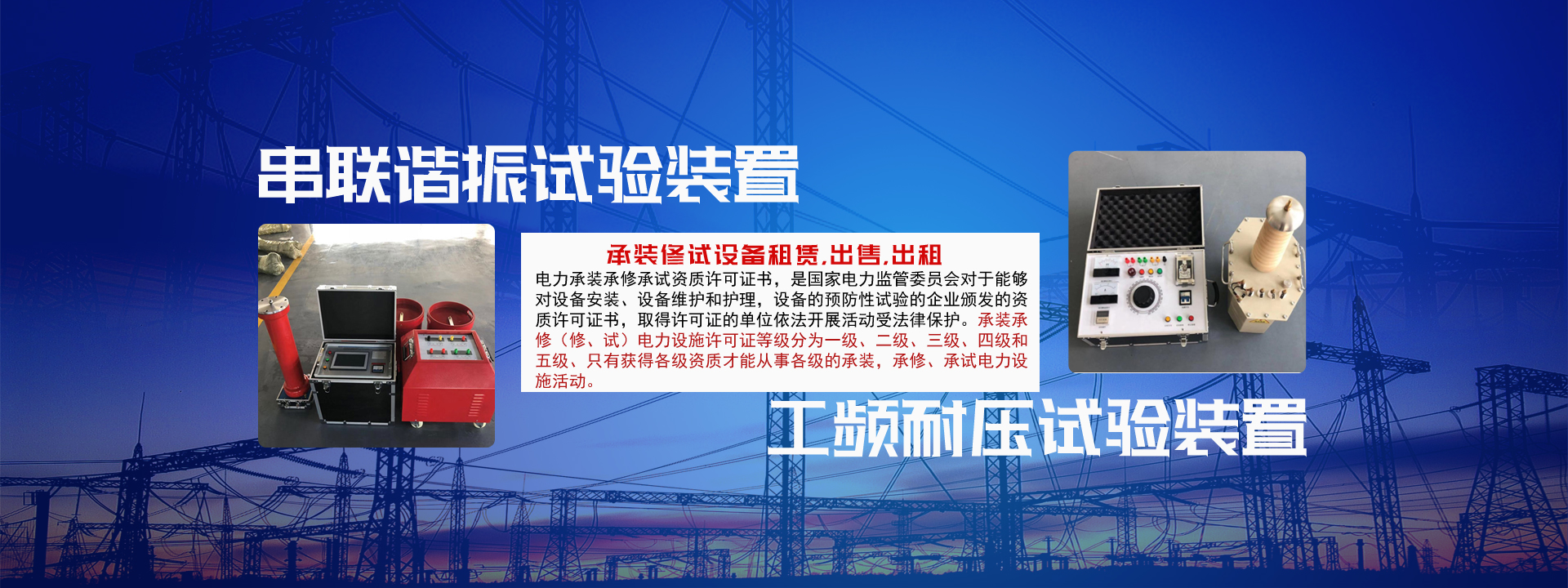
The power frequency withstand voltage test device, also known as AC withstand voltage tester or high voltage withstand voltage machine
is an important tool used to evaluate the insulation performance of electrical equipment. It applies a high voltage at power frequency (usually 50Hz or 60Hz) to test whether the equipment under test can withstand a specific voltage level within a specified time without breakdown or other failures, ensuring its safety and reliability under normal operating conditions.
Main application areas
Power systems: regular testing and maintenance of high-voltage electrical equipment such as transformers, cables, and switchgear.
Manufacturing: used for quality control during production to ensure products meet relevant standards and specifications.
Scientific research: provides a stable high-voltage power supply to support various scientific research and experimental needs.
Rail transit: used for testing and maintenance of electrical systems in vehicles such as subways and high-speed trains.
Technical principle
The working principle of the power frequency withstand voltage test device is based on converting the mains power through a step-up transformer into the required high voltage and applying it to the equipment under test. During the test, if the insulation performance of the equipment is good, it should be able to withstand the high voltage for a predetermined time without abnormal phenomena; conversely, if there is a sudden increase in current or other abnormal conditions, it indicates that the insulation of the equipment may have defects.
Features and advantages
High safety: equipped with multiple protection mechanisms such as overcurrent protection and overvoltage protection to ensure the safety of operators and equipment.
Good stability: stable output voltage with small fluctuations, ensuring the accuracy of test results.
High degree of automation: many modern models have functions such as automatic voltage regulation and automatic timing, simplifying the operation process and improving work efficiency.
Portable design: some models are compact and lightweight, easy to carry to the site for testing.
Selection guide
When selecting a power frequency withstand voltage test device, the following aspects should be considered:
Output voltage range: determine the maximum output voltage value according to actual needs.
Rated power: ensure that the device can provide sufficient power to meet testing requirements.
Accuracy requirements: for applications requiring high-precision measurement, equipment with higher accuracy should be selected.
Additional functions: for example, whether functions such as data recording and remote control meet your specific needs.
With the advancement of technology, the power frequency withstand voltage test device has not only significantly improved in performance but also made great progress in user experience and safety. These improvements aim to provide users with more efficient, reliable, and easy-to-use solutions to meet the needs of different industries. I hope this brief article can help you better understand the power frequency withstand voltage test device and its applications. If you have more specific questions or need further information, please feel free to let us know!